NASA Goddard Space Flight CenterAnna Trindade FalcãoMultiwavelength astrophysicist · Black-hole winds · AGN feedback
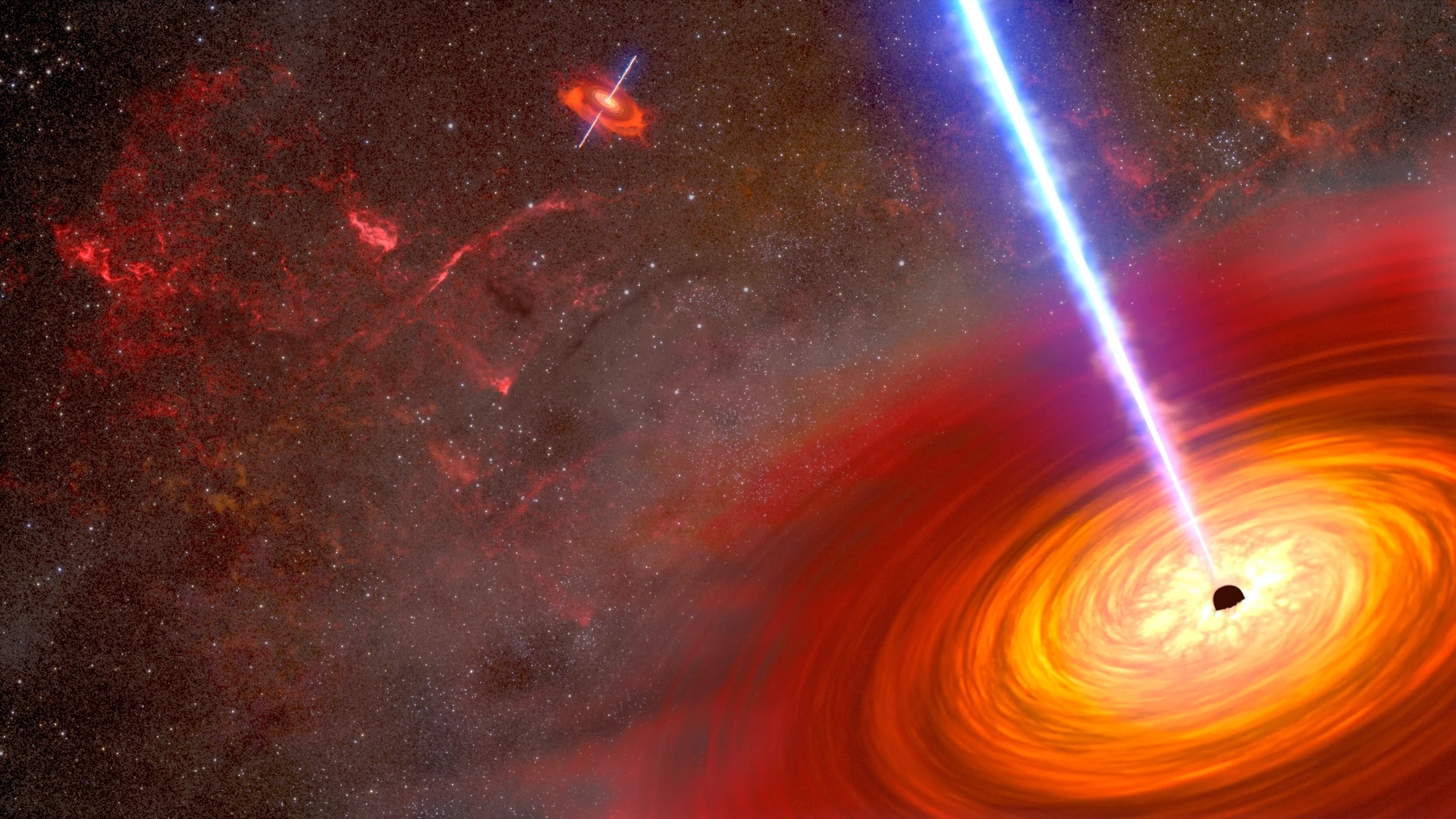
Artist’s depiction of two active black holes in merging galaxies, with a smaller distant black hole at upper left and a larger foreground black hole at lower right, each surrounded by a hot accretion disk and launching a narrow blue jet.
← All publications

The Astrophysical Journal · 2024

Resolving a Candidate Dual Active Galactic Nucleus with ∼100 pc Separation in MCG-03-34-64

Multiwavelength observations identify a candidate dual active galactic nucleus in MCG-03-34-64 on an approximately 100 pc scale; the current data do not yet uniquely exclude a single-AGN plus shocked-gas interpretation.

Artist’s concept: Artist’s depiction of two active black holes in merging galaxies, each surrounded by a hot accretion disk and launching a narrow jet. The illustration represents the candidate dual-AGN interpretation; it is not an observation of MCG-03-34-64.

NASA, ESA, Joseph Olmsted (STScI)

Paper

Resolving a Candidate Dual Active Galactic Nucleus with ∼100 pc Separation in MCG-03-34-64

Scientific overview

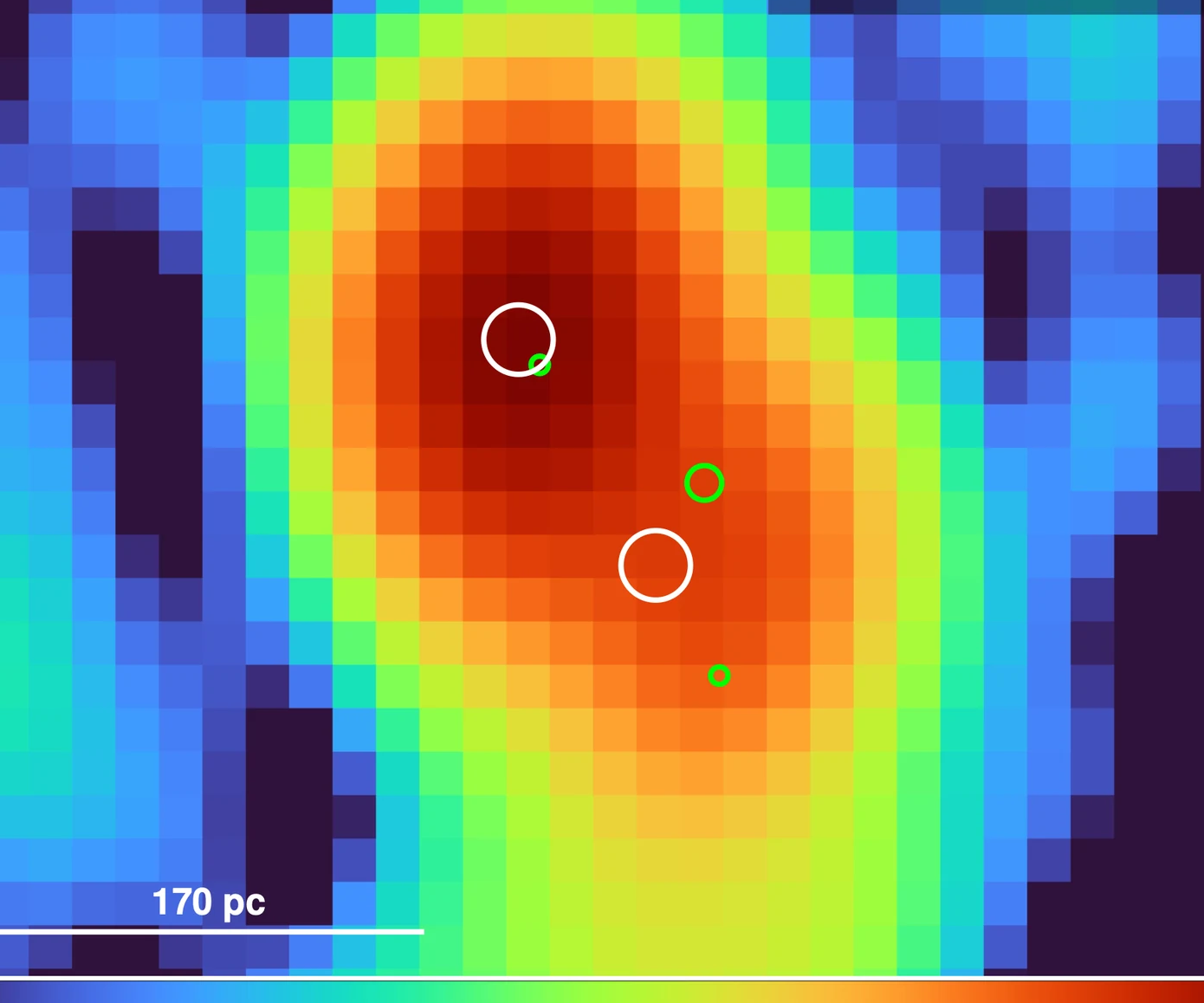
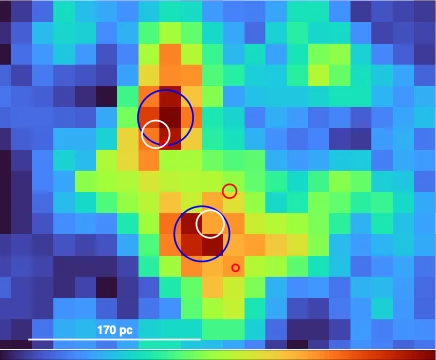
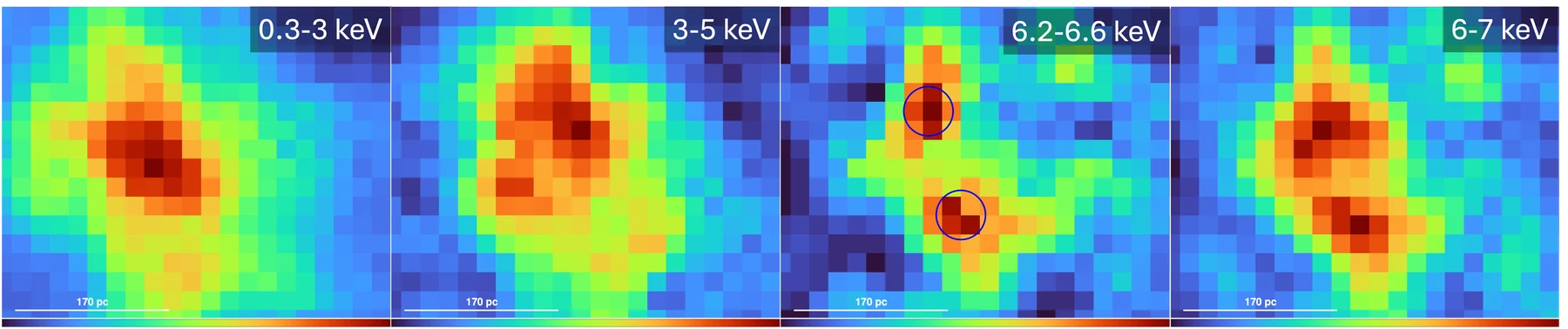
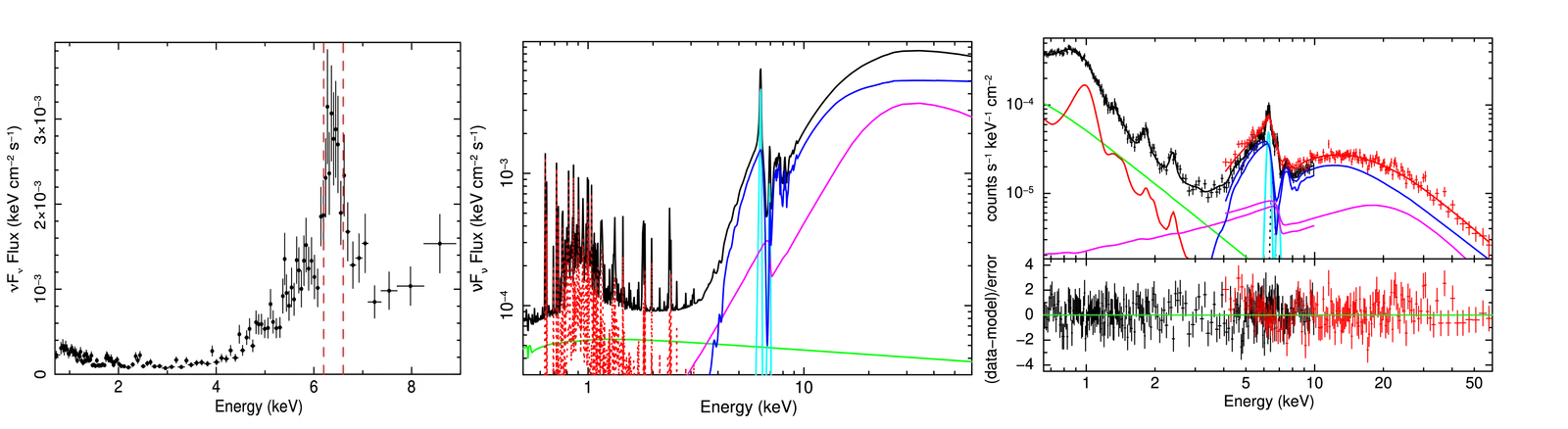
New HST/ACS and Chandra/ACIS-S observations, combined with archival HST, VLA-A, XMM-Newton, and NuSTAR data, reveal three compact optical emission regions, two spatially resolved 6.2–6.6 keV Fe Kα peaks separated by 125 ± 21 pc, and two 8.46 GHz radio centroids separated by 116 ± 14 pc. The multiwavelength centroids and Fe Kα energetics support a candidate dual-AGN interpretation, but the paper also retains a single-AGN plus shocked-interstellar-medium scenario. Deeper Chandra imaging and resolved nuclear gas kinematics are required for confirmation.

Main findings

01

HST/ACS imaging resolves three compact [O III] and F814W emission regions; adjacent [O III] separations are 79 ± 8 pc and 76 ± 8 pc.

02

Chandra resolves two 6.2–6.6 keV Fe Kα peaks separated by 125 ± 21 pc. The peaks are present in each individual observation and in the merged image; their luminosities and the derived intrinsic nuclear luminosity depend on calibration and spectral modeling.

03

VLA-A imaging shows two 8.46 GHz radio centroids separated by 116 ± 14 pc. Their correspondence with the northern and central optical and Fe Kα centroids supports, but does not confirm, the candidate dual-AGN interpretation.