01At a spatial resolution better than approximately 10 pc, the diagnostic maps identify compact Seyfert-like excitation consistent with photoionization by the low-luminosity active nucleus. It is surrounded by an approximately 10-20 pc-thick, higher-excitation subset of LINER-like pixels whose possible shock origin remains an interpretation.
02LINER-like excitation occurs on two larger spatial scales. A central region extending to approximately 1 kpc is consistent primarily with AGN photoionization, with possible shock contributions, while emission beyond approximately 2 kpc may include contributions from post-AGB stars and shocks associated with gas inflows. The imaging diagnostics do not uniquely separate these mechanisms.
03H II-like regions occur within approximately 500 pc of the nucleus and in an outer star-forming ring at approximately 4 kpc. Young stars dominate the ionization of the outer ring; the origin of the compact inner regions is less certain.
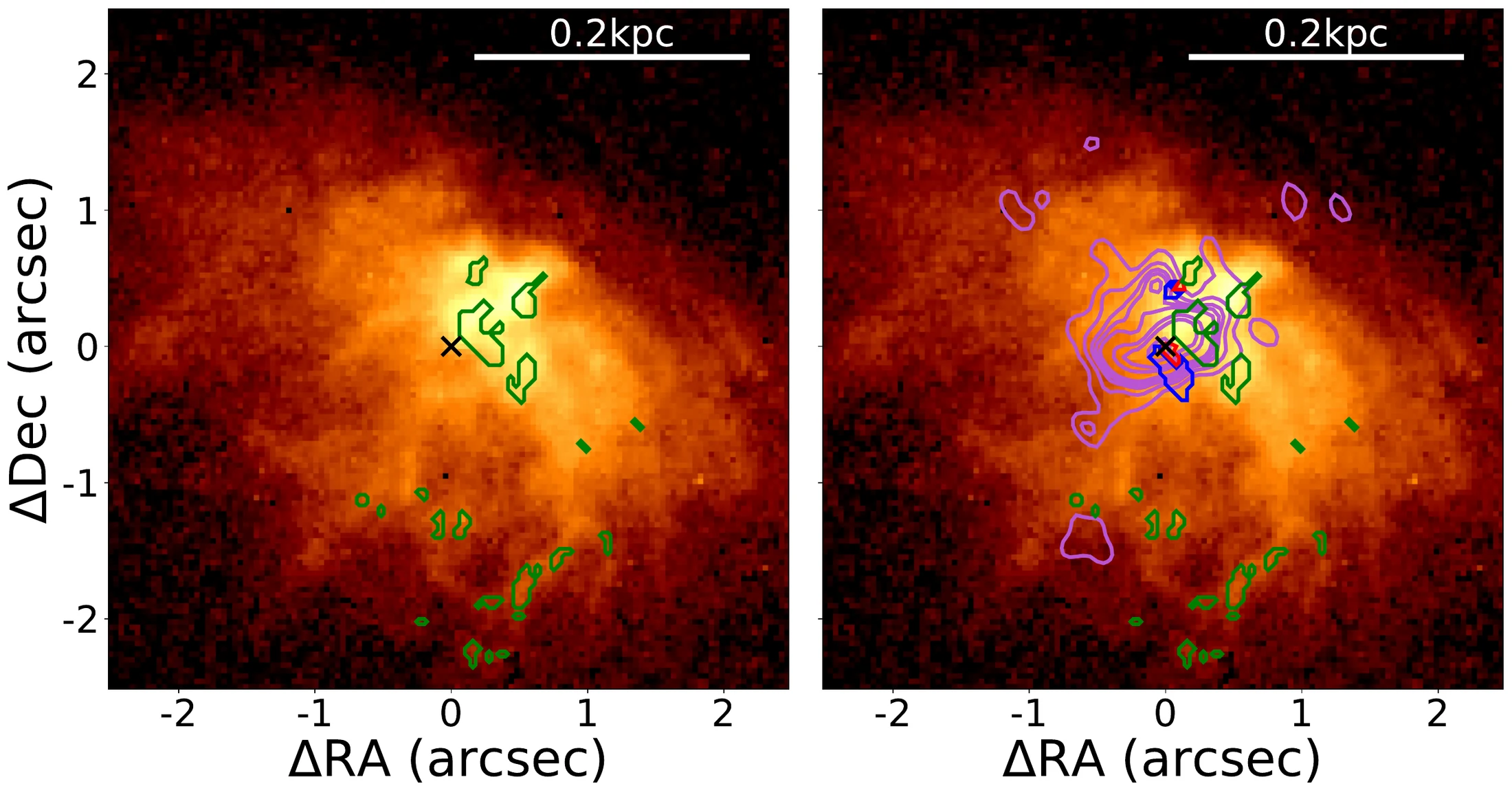
04The eMERLIN radio lobes overlap portions of the H II-like ring, and the Hα emission near the apparent southern interaction region is approximately 60% brighter than in a comparison region. The northern radio lobe does not show a similarly clear excitation enhancement. Together with the CO(1-0) morphology, these spatial relationships motivate possible jet-interstellar-medium interaction and inflow-driven shocks, but they do not establish jet-triggered star formation or causal positive feedback.