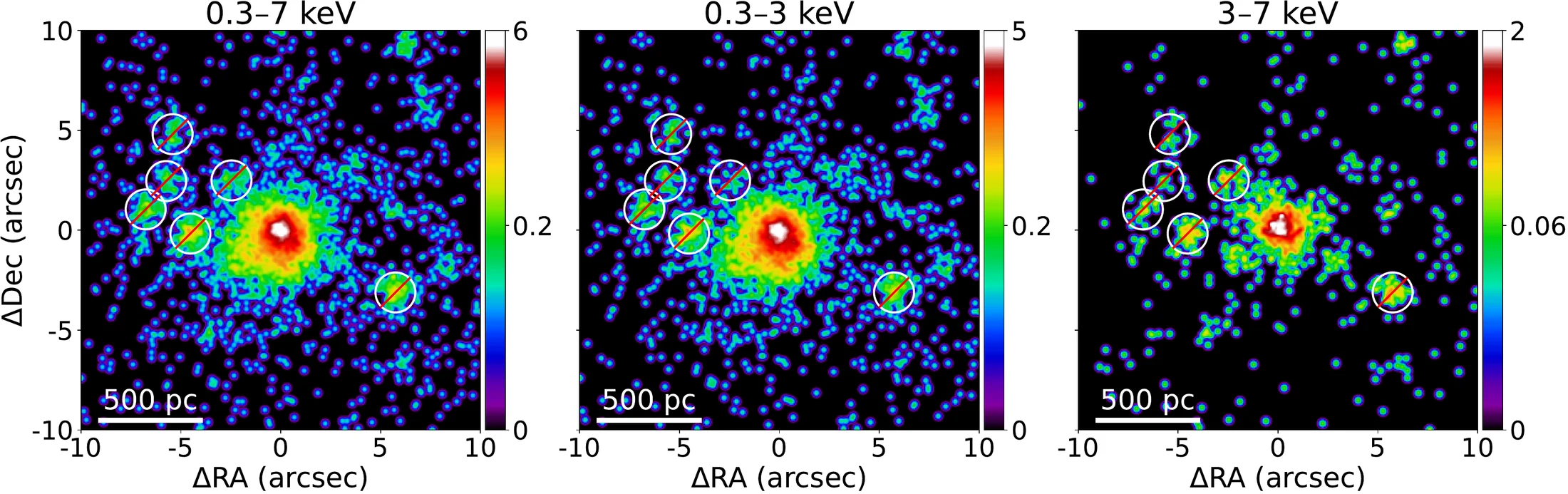
01Diffuse soft X-ray emission below 3 keV extends to approximately 800 pc, whereas emission above 3 keV is concentrated within the central approximately 400 pc. Comparison with the Chandra point-spread function confirms that the soft component is spatially extended.
02Spectra extracted from the nuclear region within 150 pc and the extended region between 150 and 500 pc are both best described by photoionized and thermal-plasma components. These components are consistent with excitation by the low-luminosity active nucleus and shock-heated gas, although the spectral decomposition does not assign every feature to a unique mechanism.
03The faint hard Chandra nuclear source, stringent NuSTAR and Swift upper limits, and agreement with the X-ray luminosity predicted from Hubble [O III] λ5007 measurements indicate an intrinsically low-luminosity, unobscured active nucleus, with a bolometric luminosity of approximately 10^41 erg s^-1 and an inferred Eddington ratio of approximately 5 × 10^-6.
04Despite the very low inferred accretion rate, the previously reported broad Hα emission is consistent with the possible persistence of a thin accretion disk and broad-line region. This interpretation challenges simple expectations for accretion-flow structure at extremely low Eddington ratios.