![Observational composites of 2MASX J13003807+5454367 and FIRST J120041.4+314745, with Chandra X-ray emission in red, Hubble [O III] emission in green, and Hubble stellar continuum in blue.](/images/press/quasar-winds/hero-quasar-winds-clean.png)
Scientific summary
Two quasars, two wind-gas relationships
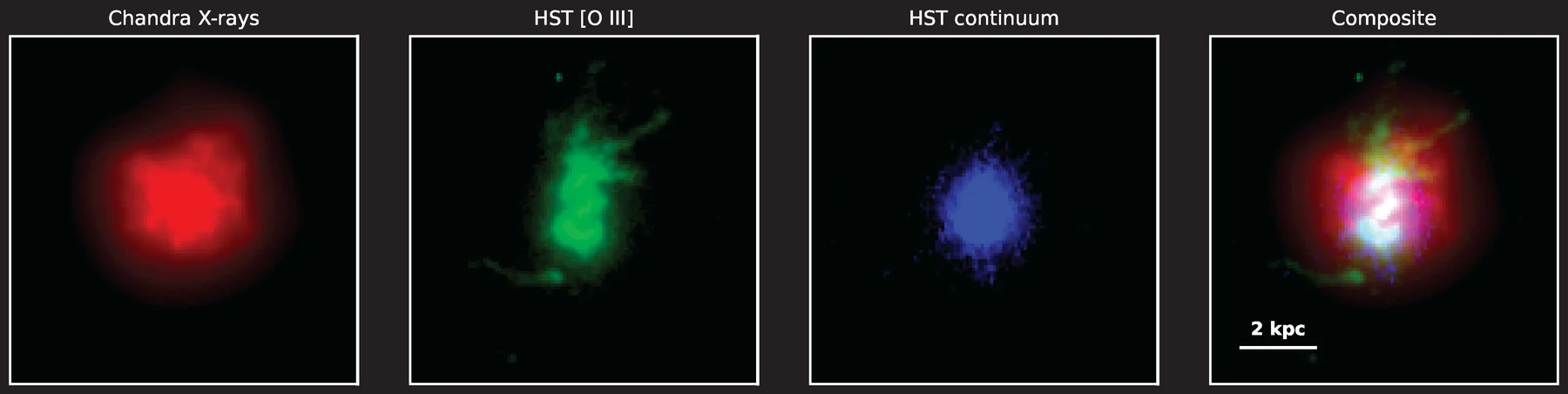
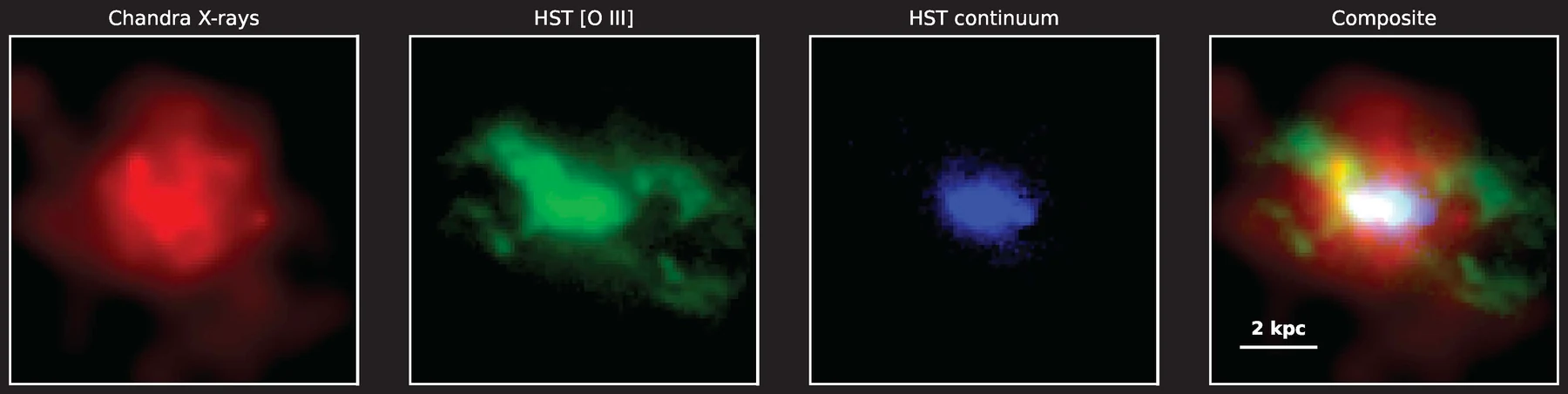
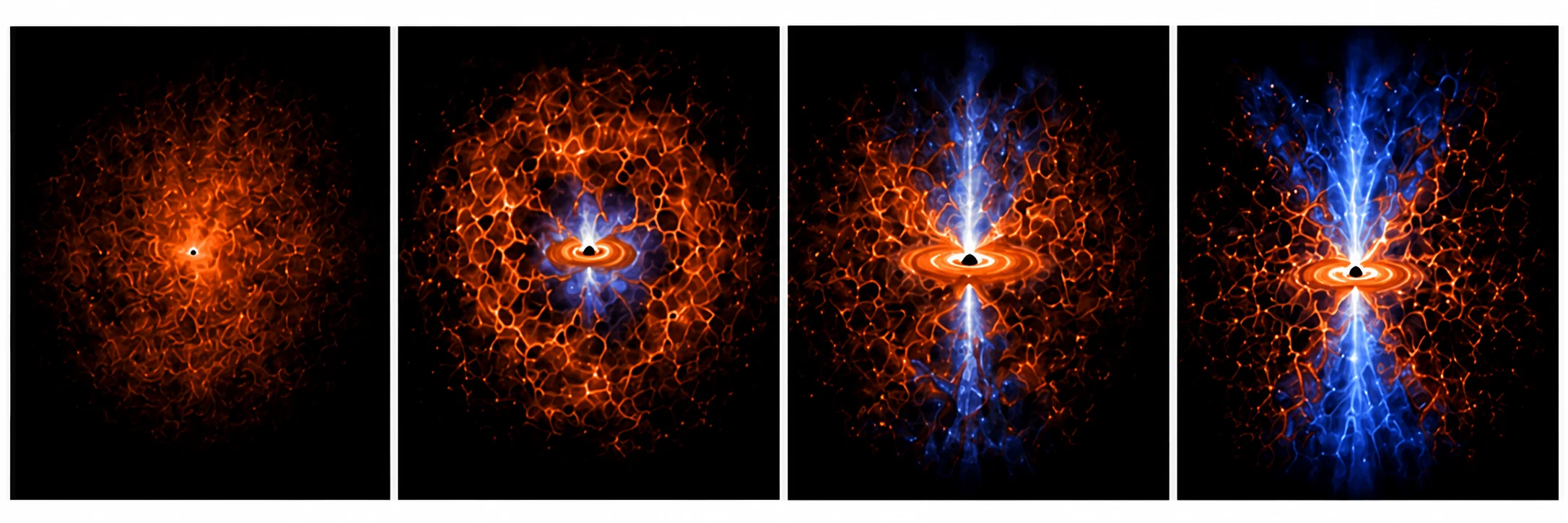
New Chandra/ACIS-S imaging spectroscopy of FIRST J120041.4+314745 and 2MASX J13003807+5454367 is compared with archival Hubble [O III] imaging and STIS kinematics. Both quasars contain kiloparsec-scale soft X-ray emission dominated by photoionized gas. In FIRST J120041, X-ray surface-brightness enhancements are co-spatial with locations where [O III] reaches its highest measured centroid velocities and line widths; in 2MASX J130038, the X-rays are more centrally concentrated and show no clear spatial correlation with the largely rotational [O III] kinematics. Considered with ten additional type 2 quasars, these contrasts motivate a proposed wind-driven feedback sequence. The study does not measure a velocity field for the extended X-ray-emitting gas or observe temporal evolution directly.