
FIRST J120041.4+314745
Extended, clumpy soft X-ray emission is projected along the [O III] bicone. The highest velocities discussed here are [O III] measurements, not X-ray-gas velocities.
Multiphase AGN OutflowsScientific story5-minute scientific story
Chandra imaging spectroscopy and Hubble observations compare extended photoionized X-ray emission with [O III] morphology and optically measured kinematics in two luminous type 2 quasars.
![Observational composites of 2MASX J13003807+5454367 and FIRST J120041.4+314745, with Chandra X-ray emission in red, Hubble [O III] emission in green, and Hubble stellar continuum in blue.](/images/press/quasar-winds/hero-quasar-winds-clean.png)
What the observations show
Hubble maps the stellar continuum, [O III] morphology, and warm-ionized-gas kinematics; Chandra resolves the soft X-ray-emitting phase. The velocities and line widths are measured from [O III], not from the extended X-ray-emitting gas.
![Four-panel observational comparison of FIRST J120041.4+314745 showing Chandra X-rays in red, Hubble [O III] emission in green, Hubble stellar continuum in blue, and the combined composite with a 2 kpc scale bar.](/images/press/quasar-winds/first-four-panel.webp)
![Four-panel observational comparison of 2MASX J13003807+5454367 showing Chandra X-rays in red, Hubble [O III] emission in green, Hubble stellar continuum in blue, and the combined composite with a 2 kpc scale bar.](/images/press/quasar-winds/2masx-four-panel.webp)
Comparing the two quasars
Both systems contain extended, predominantly photoionized soft X-ray emission, but its projected relation to the warm ionized gas differs.
Extended, clumpy soft X-ray emission is projected along the [O III] bicone. The highest velocities discussed here are [O III] measurements, not X-ray-gas velocities.
The X-ray emission is more centrally concentrated, while the measured [O III] kinematics are largely rotational and show no clear spatial correspondence with X-ray brightness.
What remains interpretive
The observations identify where projected structures coincide or separate. The distinction below keeps those measurements separate from the physical conclusions that require additional evidence.
Proposed physical framework
The two quasars do not by themselves define four evolutionary stages. Their contrasting morphologies, considered with ten additional luminous type 2 quasars, motivate four proposed observational contexts. These labels organize an interpretation; they do not define a measured evolutionary track.
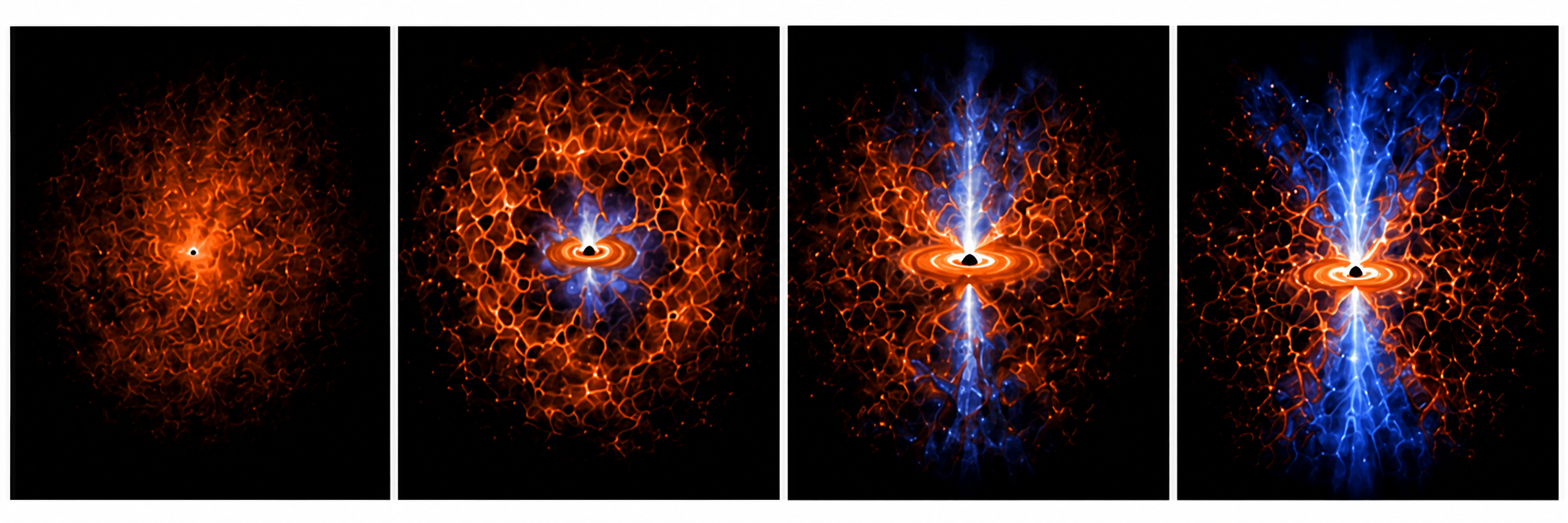
The X-ray-emitting structure is dominated by the unresolved or compact nuclear region.
Photoionized soft X-ray emission is detected beyond the unresolved nucleus.
The highly ionized X-ray-emitting and warm ionized structures become more closely aligned; alignment alone does not establish physical coupling.
Extended structures identify possible sites where a nuclear wind may affect galactic gas, pending independent dynamical and energetic constraints.
Chandra and Hubble provide complementary measurements of highly ionized X-ray-emitting and warm ionized gas. Their projected correspondence identifies candidate interaction sites, while differences between the quasars motivate a broader framework for testing how nuclear winds may affect galactic gas. Establishing dynamical coupling will require direct kinematic constraints on the X-ray-emitting phase or other independent measurements of energy and momentum transfer.
Glossary
A luminous active galactic nucleus whose central broad-line region is obscured along our line of sight, while narrow emission lines and host-galaxy structures remain observable.
Emission from doubly ionized oxygen that traces warm ionized gas. Spatially resolved line centroids and widths provide kinematic information about this gas phase.
Gas whose ionization is dominated by radiation from the active nucleus rather than assumed to arise from thermal collisions alone.
The line centroid measures the projected bulk velocity of the emitting gas, while the line width captures unresolved velocity structure and broadening within the spatial element.
Continue exploring