NASA Goddard Space Flight CenterAnna Trindade FalcãoMultiwavelength astrophysicist · Black-hole winds · AGN feedback
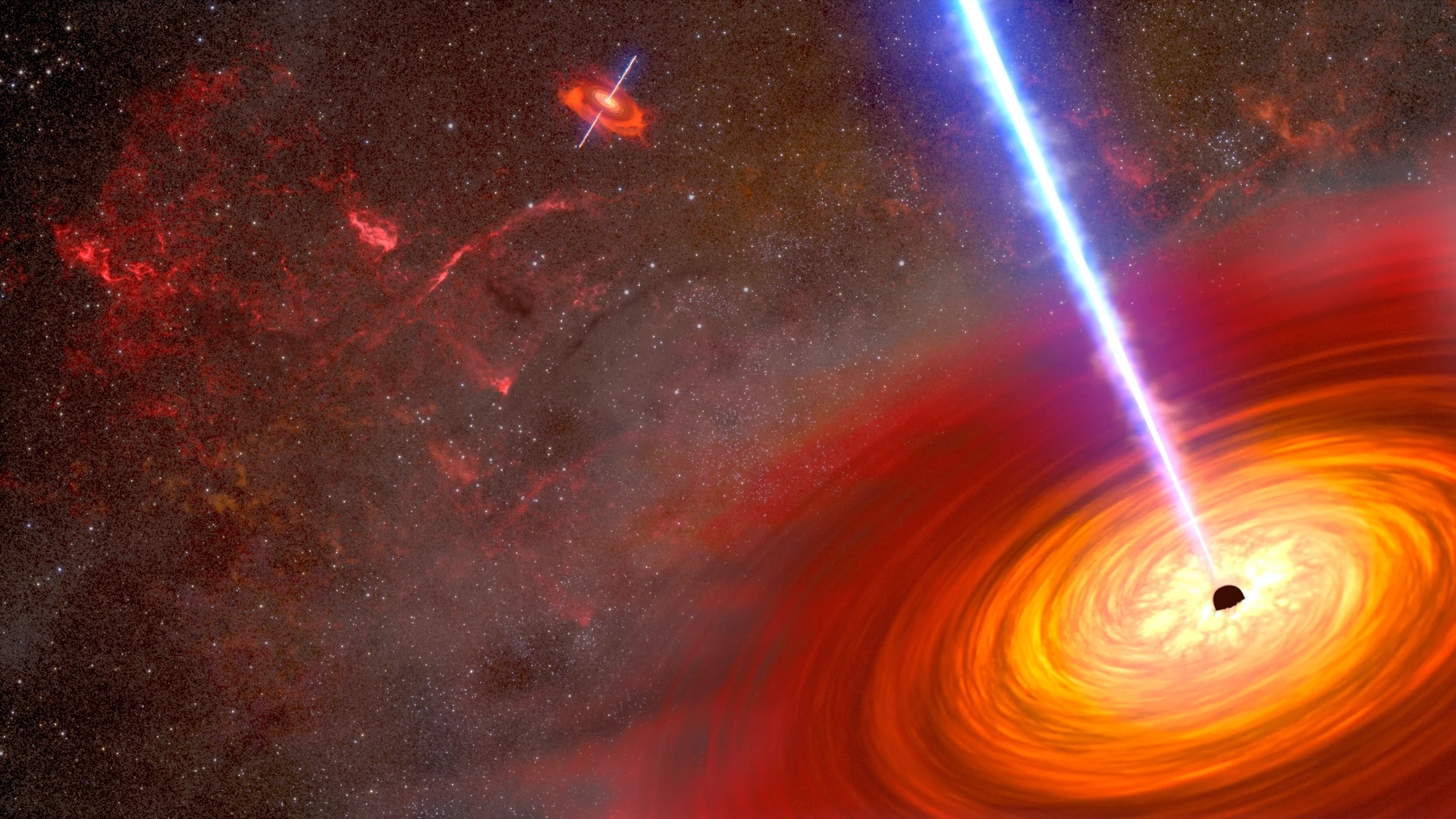
Artist’s depiction of two active black holes in merging galaxies, each surrounded by a hot accretion disk and launching a narrow jet.
← All featured releases

NASA · Featured release

A Supermassive Black Hole Duo

Chandra, Hubble, and VLA observations resolve compact structures consistent with a candidate pair of accreting supermassive black holes separated by roughly 100 parsecs.

Image: Artist’s concept · NASA, ESA, Joseph Olmsted (STScI)

The discovery

Resolving activity on a hundred-parsec scale

Chandra resolves two hard X-ray and Fe Kα peaks in the nucleus of MCG-03-34-64. Their approximately 100-parsec separation, together with compact Hubble and VLA structure, supports the interpretation of a close pair of active supermassive black holes. A single active nucleus plus shocked interstellar-medium emission remains viable; deeper Chandra imaging and resolved nuclear gas kinematics are needed to confirm the dual-AGN interpretation.

Hubble places the compact nuclear emission within the dust-rich host galaxy MCG-03-34-64.Hubble: NASA/ESA/HST; image processing: Anna Trindade Falcão.

Hubble view

An active, dust-rich galactic nucleus

The optical morphology places the compact X-ray and radio structures within the dust-rich galactic nucleus. Their relative positions provide an independent test of whether the X-ray peaks trace distinct accreting sources rather than structure around a single nucleus.

Multiwavelength evidence

Multiple tracers resolve the same nuclear scale

The candidate dual-AGN interpretation rests on the agreement between X-ray, optical, and radio positions and separations, not on any single waveband.

Chandra imaging across four energy bands isolates two compact Fe Kα peaks in the 6.2–6.6 keV band.Anna Trindade Falcão
The compact 6–7 keV morphology remains resolved across three independent Chandra observations.Anna Trindade Falcão

Supporting measurements

Radio morphology and X-ray spectroscopy

The radio and spectral measurements add independent constraints on the nature of the compact active components.

The Chandra spectrum and best-fit model isolate the Fe Kα complex near 6–7 keV.Anna Trindade Falcão
VLA 8.46 GHz radio continuum provides an independent view of the compact nuclear structure.Anna Trindade Falcão
The 6–7 keV image resolves the Fe Kα peaks and their relation to the optical and radio centroids.Anna Trindade Falcão