
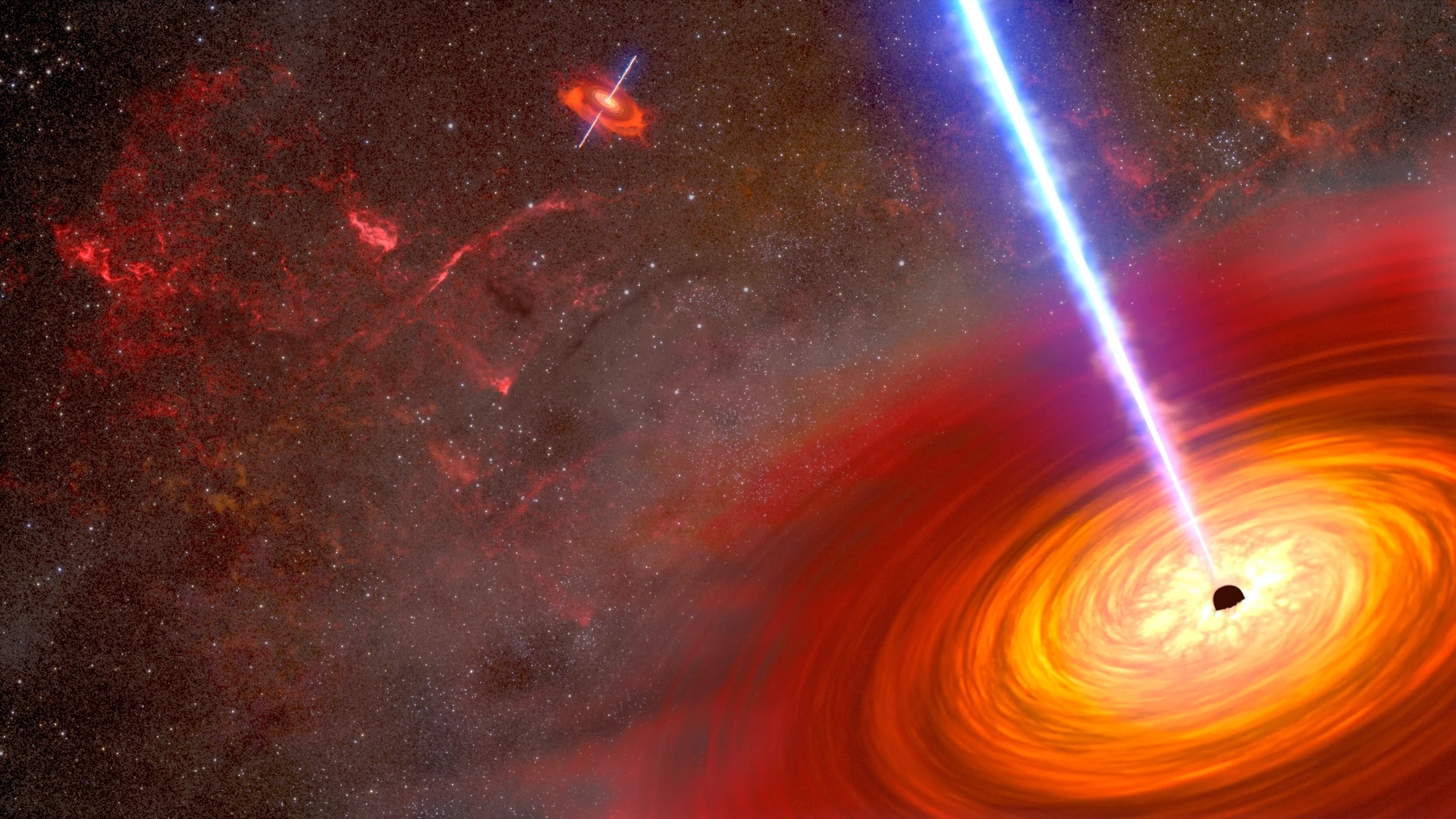
Candidate Dual Active Nuclei

Using spatially resolved multiwavelength observations to distinguish candidate dual active nuclei from complex structure around a single accreting supermassive black hole.

Artist's concept of two actively accreting supermassive black holes in the interacting nucleus of MCG-03-34-64; not an observation.
Artist's conceptNASA/ESA/Joseph Olmsted (STScI)

How I investigate this question

I compare compact Chandra, Hubble, and VLA centroids, separations, morphologies, and spectral evidence after registering each observation to a physically appropriate nuclear reference.

Observatories

ChandraHubbleVLA

What the observations allow us to test

Multiple compact peaks are treated as candidate active nuclei until their astrometry and multiwavelength properties disfavor a single AGN with shocked, photoionized, or jet-related structure.

Questions guiding this work

01

Do independent X-ray, optical, and radio peaks trace two accreting supermassive black holes or structure around one nucleus?

02

How precisely do the compact centroids and separations agree across wavebands?

03

What can close nuclear pairs reveal about the growth of supermassive black holes during galaxy interactions?

Publications and research highlights

featured releaseClose Pair of Accreting SMBHsExplore publicationA Candidate Dual Active Galactic Nucleus in MCG-03-34-64View publication