
Compton-Thick Active Galactic Nuclei

Using resolved Fe K emission and broadband X-ray spectroscopy to probe heavily obscured accretion and circumnuclear structure.

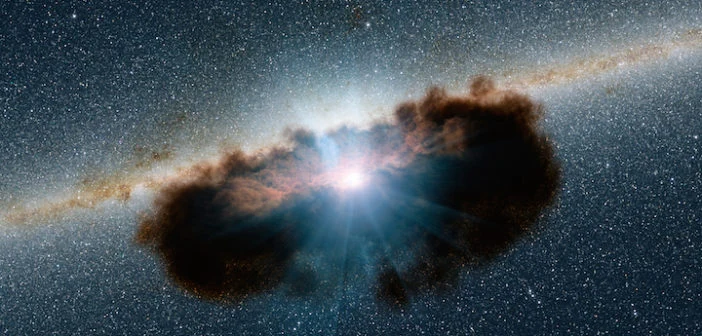
Artist's concept of a heavily obscured active galactic nucleus surrounded by circumnuclear dust.
Artist's conceptNASA · SOFIA · Lynette Cook

How I investigate this question

I use Chandra imaging spectroscopy together with broadband X-ray constraints to separate compact nuclear emission from spatially extended Fe K and continuum components.

Observatories

ChandraNuSTARSwiftXMM-Newton

What the observations allow us to test

Resolved Fe K emission constrains the distribution of circumnuclear reprocessing material; a fast outflow requires independent spectroscopic evidence and is not inferred from spatial extension alone.

Questions guiding this work

01

How is X-ray-reprocessing material distributed around a heavily obscured nucleus?

02

What can resolved Fe K emission reveal about circumnuclear reprocessing structures, and what independent spectral evidence is required to infer fast outflows?

03

How can nuclear emission be separated from extended circumnuclear components?

Publications and research highlights

publicationDeep Chandra Observations of NGC 5728 · Paper IView publication publicationDeep Chandra Observations of NGC 5728 · Paper IIView publication publicationDeep Chandra Observations of NGC 5728 · Paper IIIView publication publicationA Close Pair of Accreting Supermassive Black HolesView publication