
Highly Ionized X-Ray-Emitting Gas in Active Galaxies

Using Chandra imaging spectroscopy and physical modeling to determine what powers spatially extended X-ray emission around active nuclei.

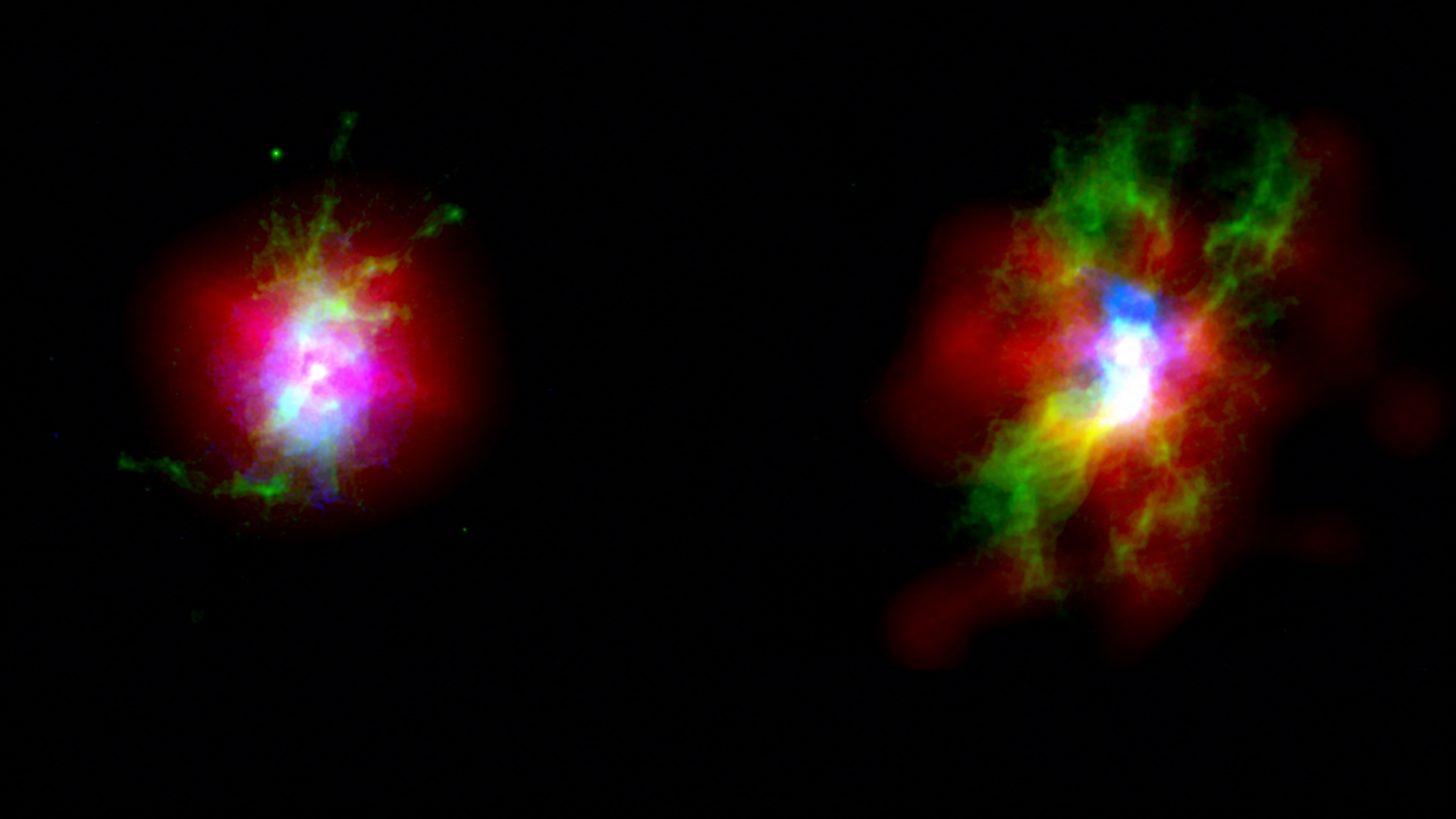
Side-by-side Chandra and Hubble observational composites of the luminous Type 2 quasars FIRST J120041.4+314745 and 2MASX J13003807+5454367.
Observational compositeX-ray: NASA/CXC; optical: NASA/ESA/HST; image processing and composition: Anna Trindade Falcão

How I investigate this question

I combine spatially resolved Chandra imaging spectroscopy with Hubble optical imaging and broadband X-ray constraints from XMM-Newton and NuSTAR to measure morphology, spectrum, ionization state, and spatial extent while accounting for unresolved nuclear emission.

Observatories

ChandraHubbleXMM-NewtonNuSTAR

What the observations allow us to test

Line-emitting X-ray gas is not assumed to be thermally hot: photoionized and collisionally ionized models are tested against the resolved spectral and morphological evidence.

Questions guiding this work

01

What powers spatially extended soft X-ray emission around an active nucleus?

02

How can photoionized plasma be distinguished from collisionally ionized gas and unresolved nuclear emission?

03

What do the morphology, spectrum, and spatial scale of the X-ray-emitting phase reveal about AGN outflows?

Publications and research highlights

publicationHot, Photoionized X-Ray Gas in Two Luminous Type 2 Quasars: Chandra-HST Evidence for a Wind-driven SequenceView publication publicationDeep Chandra Observations of NGC 5728 · Paper IIIView publication publicationDeep Chandra Observations of NGC 5728 · Paper IView publication publicationThe Weak Active Nucleus and Extended X-Ray Emission of NGC 5005View publication publicationDeep Chandra Observations of NGC 5728 · Paper IIView publication