
Research summary
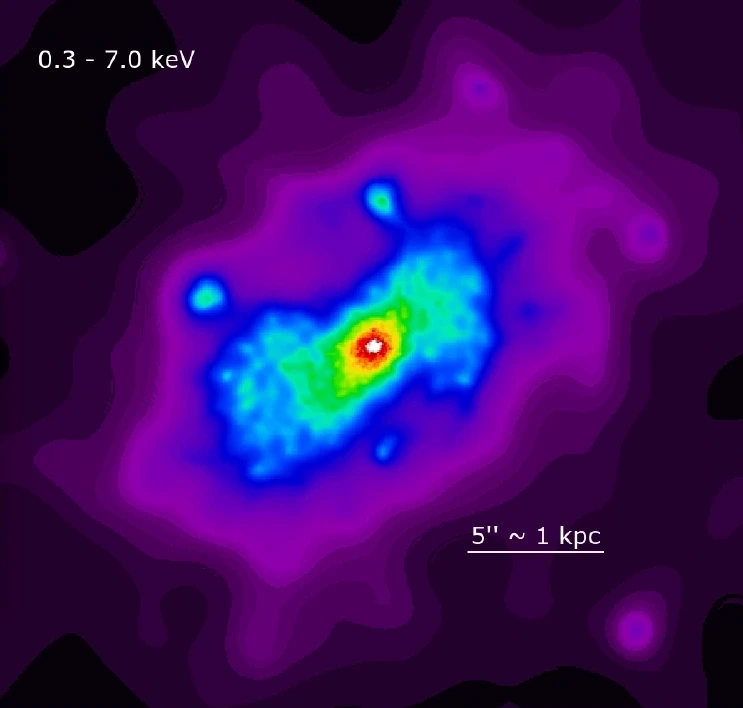
Energy-dependent extended X-ray emission in NGC 5728
Paper I analyzes eleven Chandra/ACIS-S observations of NGC 5728 totaling 260.8 ks. Registered, merged, one-eighth-native-pixel imaging and observation-specific CHART/MARX PSF comparisons show that the diffuse emission becomes less extended with increasing energy: soft emission extends approximately 2 kpc radially along the ionization bicone and approximately 1.4 kpc in the cross-cone direction, while hard-continuum and Fe Kα emission is resolved along the bicone but not established in the 3–6 keV cross-cone profile. Spectral fits to nuclear, bicone, and cross-cone regions require combinations of photoionized and, in the extended regions, thermal components; their parameters, fluxes, and inferred physical quantities are model dependent. Associations with shocks, jet–ISM interaction, clumpy-torus transmission, warm-absorber analogies, supernova remnants, or star-formation-related heating remain interpretations or alternatives. Paper I measures no X-ray or gas velocity field, does not establish causal feedback, and does not contain the later Paper II Fe-wing or Paper III multiwavelength circumnuclear results.
