NASA Goddard Space Flight CenterAnna Trindade FalcãoMultiwavelength astrophysicist · Black-hole winds · AGN feedback
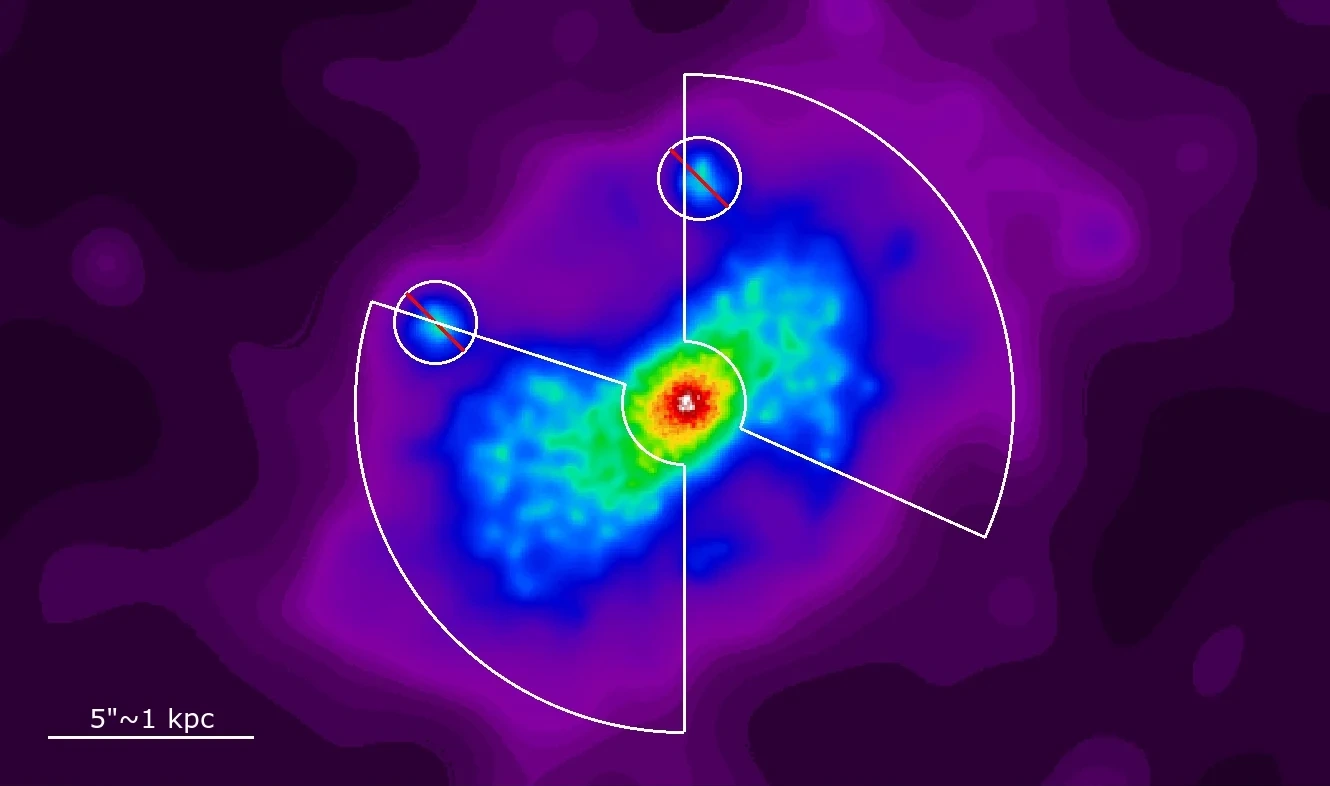
Adaptively smoothed one-eighth-native-pixel Chandra/ACIS-S 0.3–8 keV image of NGC 5728 with NW and SE extended-bicone extraction sectors from 1.5 to 8 arcsec, approximately 300 to 1600 pc, excluded nonnuclear point sources, a 5 arcsec approximately 1 kpc scale, and a counts-per-image-pixel color bar. Smoothing is not an independent resolution, velocity, outflow, or feedback measurement.
← All publications

Research article · 2024

Discovery of Kiloparsec-scale Semirelativistic Fe Kα Complex Emission in NGC 5728

ApJ 963, 6 (2024)

Paper-derived processed Chandra observational figure · Published Figure 1

Published Figure 1. Adaptively smoothed, one-eighth-native-pixel Chandra/ACIS-S 0.3–8 keV image of NGC 5728. The outlined NW and SE cone sectors are the extended-bicone spectral-extraction regions, with inner and outer radii of 1.5 and 8 arcsec, approximately 300 and 1600 pc. Marked nonnuclear point sources were excluded from the spatial and spectral analyses. The color bar reports counts per image pixel, and the figure includes a 5 arcsec, approximately 1 kpc scale. Adaptive smoothing enhances low-surface-brightness morphology but is not an independent resolution, velocity, outflow, or feedback measurement.

Trindade Falcão et al. 2024, “Discovery of Kiloparsec-scale Semirelativistic Fe Kα Complex Emission in NGC 5728,” ApJ 963, 6, DOI: 10.3847/1538-4357/ad18b3, CC BY 4.0. Published Figure 1 converted from JPEG to WebP for web presentation. Chandra: NASA/CXC.

Research summary

Kiloparsec-scale semirelativistic Fe Kα emission in NGC 5728

Paper II analyzes the combined NW and SE extended-bicone spectrum from 1.5–8 arcsec (approximately 300–1600 pc) and energy-resolved morphology from eleven Chandra/ACIS-S observations totaling approximately 260.8 ks. The bicone contains 2625 ± 51 net 0.3–8 keV counts. One-eighth-native-pixel imaging, adaptively binned or smoothed products, observation-specific MARX PSFs, an empirical PKS 1055+201 PSF, and a Her X-1 calibration comparison show PSF-relative extension along the bicone: the 5.0–6.3 keV red wing reaches approximately 6 arcsec (1.2 kpc), while the 6.3–6.5 keV rest-frame and 6.5–7.5 keV blue-wing emission reach approximately 5 arcsec (1 kpc). The bicone contains 120 red-wing, 70 rest-frame, 73 blue-wing, and 32 normalized hard-continuum counts; its 4–7 keV excess is 317 counts (approximately 15σ), while the cross-cone excess is 17 counts (1.4σ). A phenomenological fit gives red- and blue-wing significances of 5.4σ and 3.7σ, but across 33 tested spectral models the red wing remains robust at approximately 3σ or greater in nearly all cases, whereas rest-frame Fe XXV, Fe XXVI, and Fe Kβ can reduce the blue-wing significance to 1.4σ–3.7σ. Line-of-sight velocities near ±0.1c apply only if both wings are Doppler-shifted neutral Fe Kα; deprojected velocities and symmetry additionally depend on the adopted bicone geometry. Paper II does not directly measure a gas velocity field, gas mass, mass-outflow rate, kinetic energy, kinetic power, feedback efficiency, or causal feedback. Paper I morphology and spectral-mixture results are background, and Paper III multiwavelength circumnuclear results are not Paper II measurements.