
Imaging, Spectroscopy, and Physical Modeling

Using spatially resolved imaging, spectroscopy, and physical modeling to measure faint, extended emission around bright or heavily obscured active nuclei.

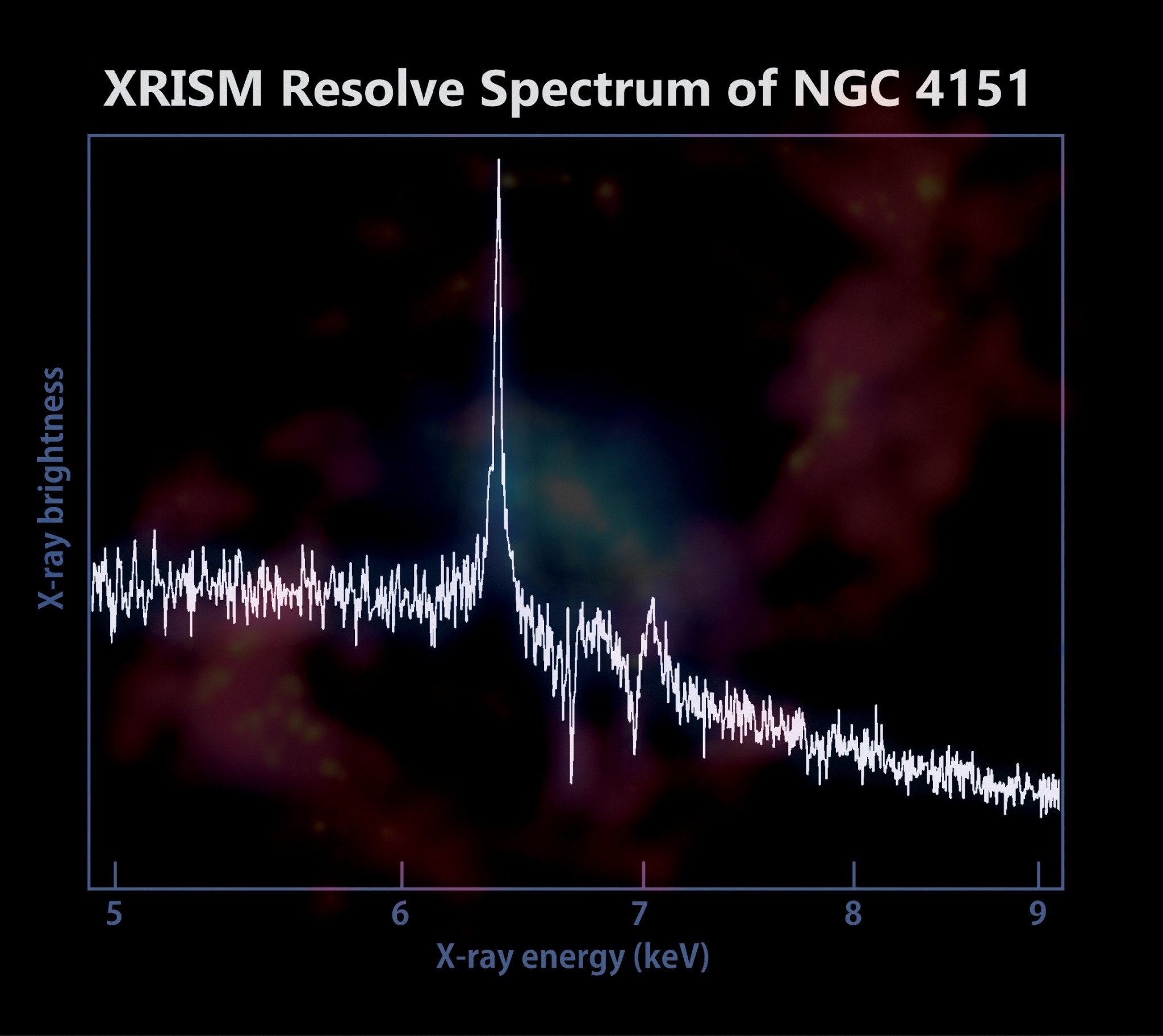
XRISM Resolve X-ray spectrum of the active galaxy NGC 4151, displayed over a multiwavelength view of the galaxy.
ObservationSpectrum: JAXA/NASA/XRISM Resolve; background: NASA/CXC/CfA/J. Wang et al., Isaac Newton Group/Jacobus Kapteyn Telescope, and NSF/NRAO/VLA

How I investigate this question

I construct instrument-aware image and spectral reductions, response products, spatial extractions, and physical models that separate compact nuclear emission from faint extended gas.

Observatories

ChandraHubbleVLTXMM-NewtonNuSTAR

What the observations allow us to test

The analysis is designed to separate nuclear and extended components, propagate observational uncertainties, and test competing physical models for the emitting gas.

Questions guiding this work

01

How can spatially resolved spectroscopy isolate faint photoionized and outflowing gas around obscured active nuclei?

02

Which analysis strategies developed for obscured AGN can be extended to Type 1 sources, where direct nuclear emission is much more prominent?

03

How can reductions, response generation, spectral modeling, and validation be documented so that computational reproducibility remains distinct from physical interpretation?

Publications and research highlights

publicationHot, Photoionized X-Ray Gas in Two Luminous Type 2 Quasars: Chandra-HST Evidence for a Wind-driven SequenceView publication publicationTracking X-Ray Outflows with Optical and IR Footprint LinesView publication publicationDeep Chandra Observations of NGC 5728 · Paper IIIView publication publicationDeep Chandra Observations of NGC 5728 · Paper IIView publication publicationThe Multiphase Nuclear Environment of NGC 5005 · Paper IIView publication